Here's a big digital accessibility secret. Making a product accessible is the easy part. Keeping it accessible is the hard part.
The hard part (organizational change in policy, process, and action) is why governments and businesses fall out of compliance. Even with the deadline pushed out 12 months, this is why everyone waiting to comply with the new Title II and HHS digital accessibility guidelines will fail.
They don't know what they don't know.
The other not-so-big secret is that governments and businesses can be sued today for digital accessibility violations. The new standard only names a conformance standard and broadens the scope to include social media, PDFs, and videos. A delay in the deadline doesn't get your organization off the hook today.
The obligation remains: provide effective communication and equal access under the Americans with Disabilities Act and parallel state civil rights laws, which have been on the books for decades. Those obligations are in effect right now, are enforceable, and have been litigated repeatedly.
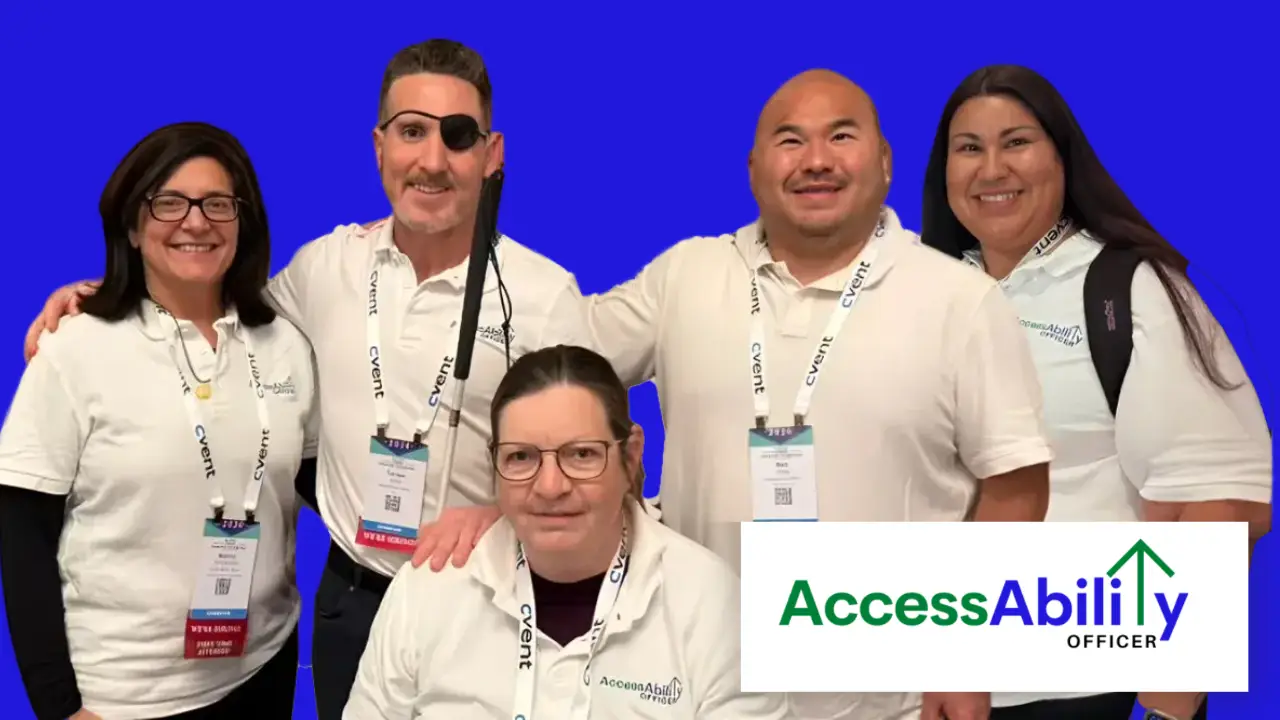
There's good news. Most teams don't have to travel this road alone. These are exactly the gaps an experienced AccessAbility Officer consultant, whether fractional or full-time, is built to close.
If you’re running a product team and haven’t seriously started the process of conforming to WCAG 2.1 Level AA, you’re not ahead of the deadline. You’re six months behind.
Two Different Clocks, Often Confused
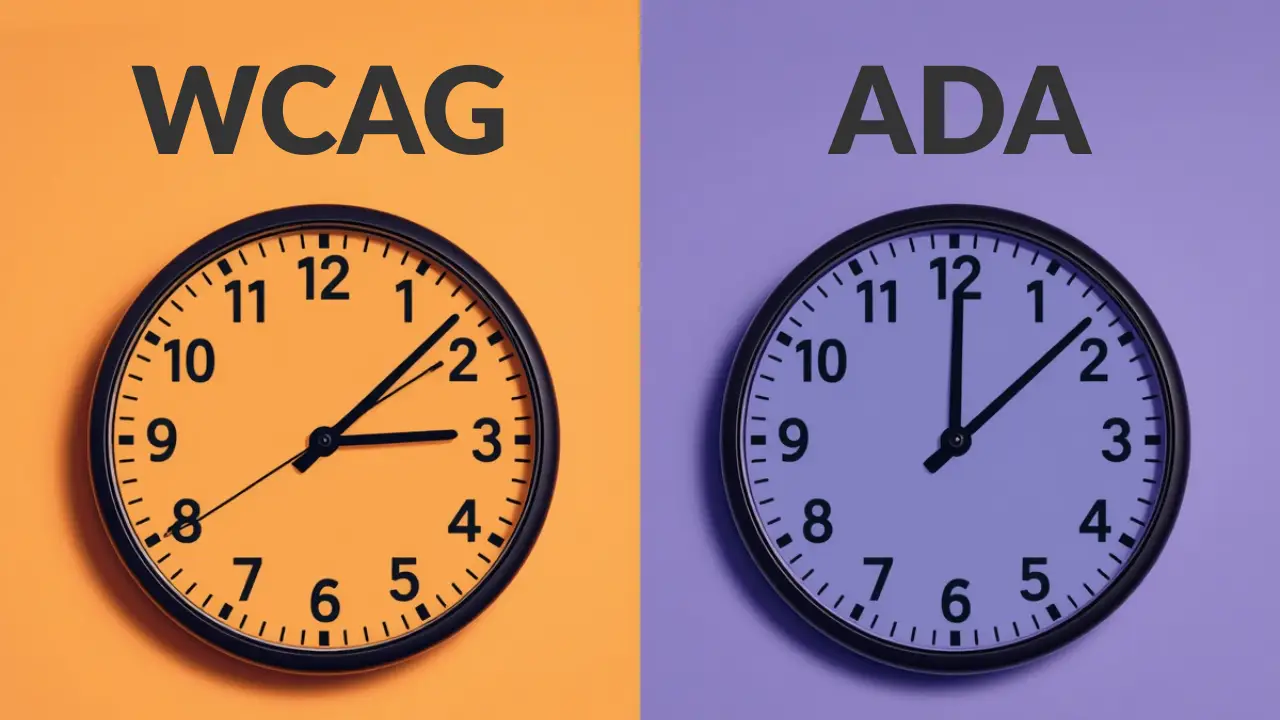
It helps to separate two things that often get collapsed in this conversation.
The technical standard. WCAG 2.1 Level AA is a detailed, testable specification for how digital interfaces should behave so that people using assistive technology, keyboard navigation, screen magnification, captions, and other accommodations can use them. Conformance is measurable; you either conform or you don’t. There are auditors, automated scanners, and well-defined success criteria.
The underlying legal duty. The ADA, Sections 504 and 508 of the Rehabilitation Act, state human rights and Unruh-style civil rights laws, and a long line of court decisions established a duty for businesses to provide effective communication and equal access long before WCAG existed. That duty is technology-neutral. It does not matter whether your product is a website, a mobile app, a kiosk, a portal, or a dashboard that requires a login. The question is whether a person with a disability can independently access the same information, conduct the same transactions, and enjoy the same services as everyone else.
A regulator can extend the measurement date. A regulator cannot extend the civil rights statute that underlies it. Plaintiffs’ firms know this. State attorneys general know this. The Department of Justice has said so explicitly, more than once. The deadline extension merely changed the date on which WCAG 2.1 Level AA becomes the accessibility standard, not the date organizations were required to be accessible.
Why Accessibility Takes 18 to 24 Months or longer, Not Twelve

When a team takes an existing inaccessible product, of any size, and decides to bring it into compliance with WCAG 2.1 Level AA, the realistic timeline is generally eighteen to twenty-four months.
The reason it takes that long is that accessibility is not a feature you can bolt on at the end. It touches design tokens, component libraries, content, code, QA, vendor contracts, and the way the team works. A serious remediation effort generally moves through several overlapping phases:
- Discovery and audit. A combination of automated scanning, manual expert review, and assistive-technology testing across representative pages, flows, and components. For a non-trivial product, this is rarely shorter than two to three months.
- Design system remediation. Color contrast, focus states, target sizes, error patterns, form behavior, and component semantics typically need to be fixed at the system level before downstream pages can be fixed durably. Otherwise, teams remediate the same defect dozens or even hundreds of times.
- Responsive Breakpoints. Many software companies think, “I’m not supporting mobile, so I don’t care about this.” Surprise! The same approach that makes mobile formats work is also needed for magnification. This may show up as a single defect, but it may be the most time-consuming defect to fix by orders of magnitude.
- Content and media. Alt text, captions, transcripts, document remediation for PDFs, and rewriting content that depends on color or sensory characteristics alone. This work scales with the size of the content library and is almost always underestimated. Most people have WAY more content deployed on YouTube than they realize.
- Engineering remediation. Semantic HTML, ARIA used correctly and sparingly, keyboard interaction patterns, focus management for dynamic content, and integration with assistive technology.
- Third-party and vendor components. Payment widgets, video players, chat tools, analytics overlays, cookie banners, and embedded SDKs. Each one is a separate negotiation, sometimes a separate procurement cycle, and sometimes a “this tool needs to be replaced” project.
- Testing and validation. Real users with disabilities, screen reader testing across at least the major combinations, keyboard-only walkthroughs, regression test suites, and a documented conformance report. This is not a final-week activity; it runs alongside everything else.
Making a product accessible is the easy part. Keeping it accessible is hard. Making a product accessible largely comes down to education, tooling, and tech. Keeping it accessible requires change, and significant investment in these three categories in addition to all the technical pieces:
- Policy change. Codifying the new expectations so they survive turnover, reorgs, and the next quarterly priority shuffle. This includes a written accessibility policy with a named executive owner, a public accessibility statement and feedback channel, a procurement standard requiring VPATs and contractual conformance commitments from vendors, a definition of done that blocks release on known critical accessibility defects, an incident and remediation process for issues reported by users, and a documented escalation path when business pressure pushes back against the standard. Without policy, every accessibility decision is relitigated from scratch; with it, the answer is already on the page, and the conversation moves to execution.
- Process change. Design reviews that include accessibility, definition-of-done criteria, training for designers and engineers, accessible authoring guidance for content teams, and a procurement gate to prevent the next vendor contract from reintroducing the problem. Without this, the product regresses within a release or two.
- Culture change. Shifting the organization from treating accessibility as a compliance artifact to treating it as a quality attribute owned by everyone who ships. This means designers who learn to think in keyboard order and screen reader semantics rather than only in pixels, engineers who treat an inaccessible component as broken rather than as a known limitation, product managers who write acceptance criteria that include disabled users by default, and leadership that asks about accessibility in the same review where they ask about performance and security. Without this shift, the program lives or dies with whichever specialist happens to be in the room, and the moment that person leaves, the regression begins.
None of this can be compressed into a year, and if it is, what you likely have is a product that passes an automated scan once and nothing more.
If You Start Today, You Are Already Behind. Waiting Makes it Even Worse

The arithmetic is unforgiving. If a realistic remediation program takes eighteen to twenty-four months and a deadline is twelve months away, a team starting today is already behind on the technical standard, even before the legal duty enters the conversation.
Behind is not the same as doomed. Teams catch up all the time, especially if leadership treats this as a real program with a budget, an owner, and a roadmap rather than a ticket on a backlog, and especially when an AccessAbility Officer is brought in early to partner with internal teams rather than parachute in at the end. But catching up requires acknowledging the gap rather than trying to cover it up. The most expensive accessibility programs are the ones that started by assuming there was more time than there actually was.
Demand letters, structured negotiation requests, and lawsuits do not wait for a regulatory measurement window to open. You could get sued or lose a deal today.
What “Making a Product Accessible” Actually Requires
Executive commitment. Successful accessibility programs have a named owner with authority, a budget that is not raided every quarter, and explicit air cover to slow feature work when more time is needed for accessibility. Programs that fail are usually structured as a side project for a single staff member who already has a full roadmap.
A current, honest baseline. Not an automated scan emailed to the legal department. A real audit that tests with assistive technology, looks at the flows that matter most to users, and produces a remediation backlog that engineering can actually estimate. This is one of the places a seasoned AccessAbility Officer earns their keep, because a baseline produced by someone who has lived through dozens of these efforts looks very different from one produced by a tool. You cannot plan a recovery from a position you have not measured. You also can’t measure progress if you don’t know where you are starting from.
Systemic fixes, not page-by-page patching. The most leveraged work is in the design system, component library, content templates, and procurement process. Fixing those once fixes thousands of downstream defects. Fixing pages one at a time guarantees that new pages will be born broken.
Ongoing maintenance, not a one-time project. Accessibility is closer to security than it is to a launch. It needs monitoring, regression testing, training for new hires, and review of every new vendor and feature. A product that is in conformance in March can drift out of conformance by July if no one is watching the door.
A willingness to change the way things are done. Accessibility exposes bad habits that people have relied on for years to compress schedules: the design review that skips keyboard testing, the sprint that ships a feature marked "we'll fix the screen reader pass later," the procurement decision made on price alone, and the content workflow that treats alt text as an afterthought. Real conformance is not achievable without breaking those habits, and that change will be uncomfortable. Teams that succeed accept early that some sacred cows must move, that some velocity will be traded for quality, and that "this is how we've always done it" is not a defense. Teams that fail try to bolt accessibility onto an unchanged process and are surprised when the same defects keep reappearing, release after release.
The Practical Takeaway
The extended deadline is not a reprieve. It is a measurement window for a standard that sits atop a civil rights framework, already binding, for which tens of thousands of organizations have paid out hundreds of millions of dollars in damages and legal fees. A team that treats the next twelve months as breathing room is making a strategic error that will be costly to unwind, both in remediation costs and in legal exposure.
A team that treats the next twelve months as the back half of an eighteen- to twenty-four-month program and starts immediately has a credible path. The work is unglamorous, deeply cross-functional, and almost always longer than the first estimate. It is also one of the few investments in product quality that simultaneously expands the addressable market, improves the experience for every user, and reduces a category of legal risk that has been growing every year.
The question is not whether to start. The deadline has already answered that, and so has the ADA, decades ago. The question is whether to start now, while there is still room to do the work properly, or to start later and pay for the compression. Either way, the journey goes faster and lands better with the right partner walking it with you, and an AccessAbility Officer is exactly that kind of partner.