For improved accessibility, including chapter navigation and transcript, view this video on YouTube.
" Don't you have someone who can help you? "
For many blind and disabled Americans, that's the response they hear when an inaccessible website, portal, or online form prevents them from completing a task independently.
But what if you don't want a helper?
What if you want the same privacy everyone else has when accessing your medical records?
What if you have to answer personal medical questions out loud because the system isn't accessible?
What if independence isn't a convenience, but a right?
In May 2026, the U.S. Department of Health and Human Services (HHS) announced an Interim Final Rule (IFR) extending the compliance deadlines for digital accessibility requirements under Section 504 of the Rehabilitation Act.
For healthcare organizations, it may feel like additional time.
For many people with disabilities, it feels like more waiting.
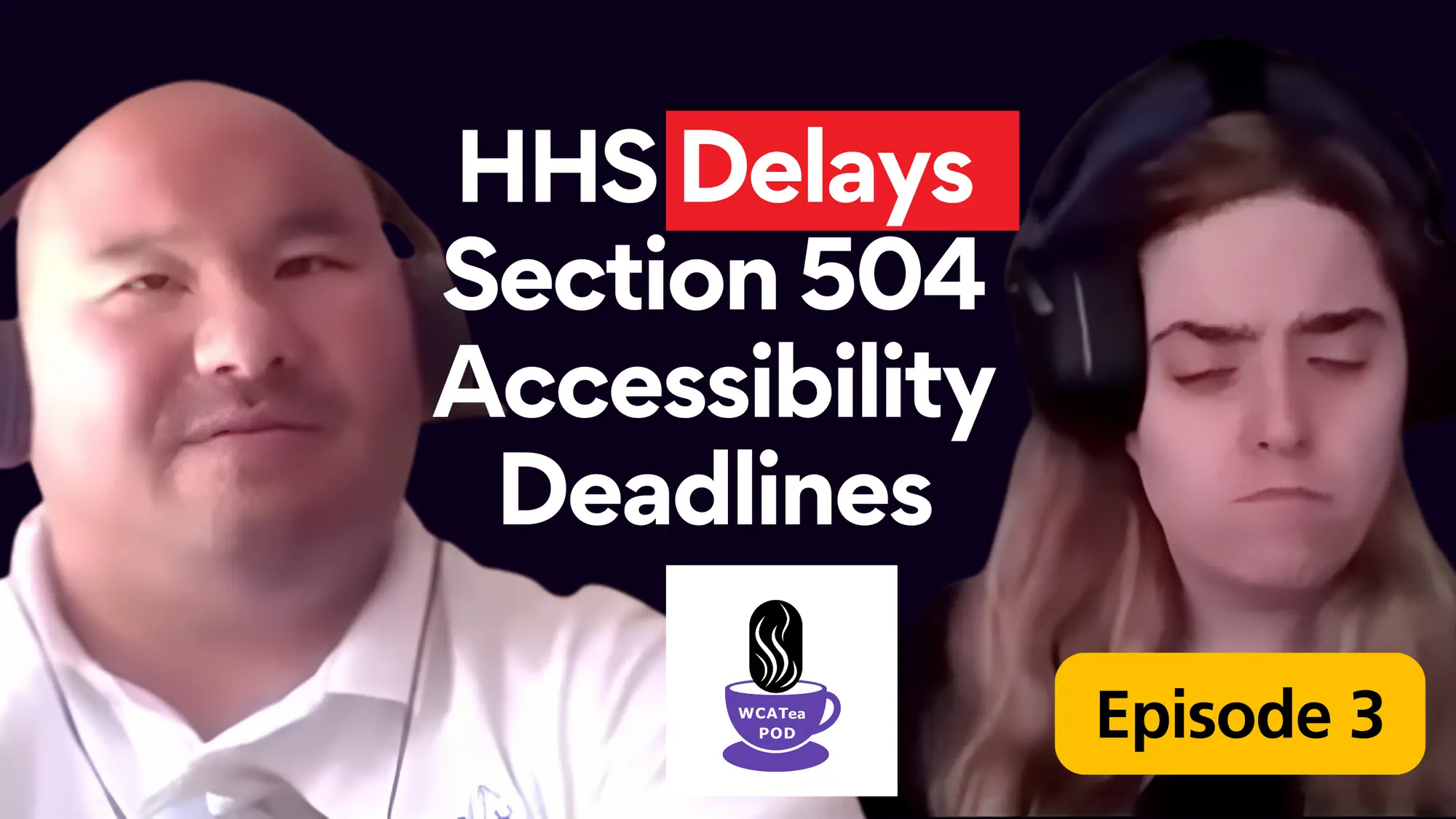
That's exactly what Bee Yang and Ellie Alvarado discuss in the latest episode of WCATea.
As blind professionals, parents, and advocates, Bee Yang and Ellie Alvarado explore what happens when equal access is delayed... and who bears the cost of waiting.
Listen to the Full WCATea Conversation
What Changed Under the HHS Section 504 Accessibility Rule?
Nothing, except the deadline has been extended by 1 year. Entities with 15 employees or more have until May 15, 2027 to comply with WCAG 2.1 AA and all organizations (including those with less than 15 employees) must be compliant with WCAG 2.1 AA by May 15, 2027. All businesses, agencies and organizations receiving federal funds from HHS to make their websites, documents, mobile apps, and other digital communications accessible with WCAG 2.1 AA.
These requirements apply to any "recipient" of HHS funds, including state and local governments, public or private agencies, institutions, businesses, organizations, and individuals receiving federal financial assistance from HHS. For example:
- State and local health and human services agencies
- County health departments
- Medicaid agencies plus their contractors and vendors
- Hospitals and health systems
- Doctors, clinics, and community health centers accepting Medicare or Medicaid
- Behavioral health and substance use treatment providers
- Child welfare, foster care, aging, disability, and social service programs
- Colleges, universities, training programs, and nonprofits receiving HHS grants
- Private vendors or contractors who themselves are recipients or subrecipients of HHS funds
HHS Office for Civil Rights announcement
What is the new compliance deadline for HHS and Section 504?
| Organization Size | Original Deadline | New Deadline |
| 15 or more employees | May 11, 2026 | May 11, 2027 |
| Fewer than 15 employees | May 10, 2027 | May 10, 2028 |
Public comments regarding the Interim Final Rule may be submitted through July 6, 2026.
Federal Register Notice – Extension of Compliance Dates for Accessibility Requirements
Why does the HHS deadline for digital accessibility compliance Matter so much to People with Disabilities?
For many people with disabilities, accessibility affects more than convenience.
It can affect privacy, independence, communication, and access to healthcare services.
When websites, patient portals, forms, and mobile applications are inaccessible, individuals may face barriers that others never encounter.
That's why many disability advocates view accessibility as a healthcare access issue rather than simply a compliance requirement.
Why are Disability Advocates so Oppose to the HHS and Section 504 Delays?
The American Council of the Blind (ACB) has publicly opposed the extension.
According to ACB, the original accessibility requirements followed approximately 14 years of consideration, stakeholder engagement, rulemaking activity, and public feedback before becoming final in 2024.
ACB argues that extending compliance deadlines forces people with disabilities to wait longer for equal access to healthcare information, websites, mobile applications, and online services.
The organization has also announced plans to submit formal comments opposing the Interim Final Rule.
American Council of the Blind statement on the HHS Interim Final Rule
Why digital accessibility is so important to Healthcare for people with disabilities?
For many organizations, this announcement is about deadlines.
For many people with disabilities, it's about daily life.
According to the Centers for Disease Control and Prevention (CDC), approximately 1 in 4 adults in the United States lives with a disability, representing more than 70 million Americans.
Today, healthcare increasingly relies on websites, patient portals, mobile applications, telehealth platforms, and other digital services.
For many patients, these systems have become the front door to healthcare.
When those systems are inaccessible, barriers to healthcare don't disappear simply because a deadline has been extended.
CDC Disability and Health Overview
What impacts do inaccessible websites have on healthcare?
Healthcare providers may offer accommodation through alternative methods.
However, disability advocates argue that people with disabilities should not have to depend on workarounds to access healthcare information and services.
Common accessibility barriers can affect a person's ability to independently access healthcare online.
What are common Accessibility Barriers in healthcare and Their Impacts?
As healthcare continues shifting online, accessibility increasingly becomes a healthcare access issue.
| Accessibility Barrier | Potential Impact on Healthcare Access |
| Inaccessible telehealth platforms | Patients may encounter barriers participating in virtual healthcare appointments |
| Inaccessible patient portals | Delayed access to medical records, test results, and provider communications |
| Inaccessible prescription management tools | Difficulty refilling prescriptions or reviewing medication information |
| Inaccessible PDFs and healthcare documents | Medical instructions, discharge paperwork, and healthcare information may be unavailable |
| Uncaptioned healthcare videos | Deaf and hard-of-hearing users may miss important healthcare information |
| Poor keyboard navigation | Users may be unable to access critical healthcare content and services |
Could HHS Change Section 504 Accessibility Requirements Again?
The deadline extension may not be the only change on the horizon.
In the Interim Final Rule, HHS stated that it may consider future substantive changes to the regulations implementing Section 504 of the Rehabilitation Act.
At this time, HHS has not announced what those changes might be.
However, that statement has raised questions among disability advocates, healthcare organizations, and accessibility professionals about the future direction of digital accessibility requirements.
For now, the only confirmed change is the one-year extension of compliance deadlines. Any future modifications would require additional regulatory action and public input.
How to get involved in the HHS Section 504 Public Comment Process?
The deadline moved. The opportunity to speak up hasn't.
The public comment period remains open through July 6, 2026.
People with disabilities, family members, healthcare professionals, advocates, and allies can submit comments and share their experiences.
Because accessibility isn't just about websites.
It's about independence.
It's about privacy.
It's about dignity.
And it's about whether people with disabilities can participate in healthcare on equal terms.
How do I Submit a public comment on the HHS Section 504 Accessibility Rule?
Regulations.gov Public Comment Portal
Listen to the Full WCATea Conversation
In this episode, Bee Yang and Ellie Alvarado discuss the HHS accessibility delay, what it means for people with disabilities, and why many advocates are concerned about the precedent it may set.
How do I prepare for the new HHS and Section 504 Digital Accessibility Requirements?
AccessAbility Officer helps government agencies, GovTech vendors, healthcare companies and providers, and businesses achieve, monitor and maintain WCAG digital accessibility compliance through our suite of tools, auditing services, training, experts on-demand, and world-class remediation supports.
Learn more about AccessAbility Officer's services here:
https://accessabilityofficer.com/accessibility-management
Explore Digital Accessibility Training:
https://accessabilityofficer.com/digital-accessibility-training